domenica 24 luglio 2016

domenica 5 giugno 2016
Henri Pape's patent felt and it's application on Pleyel pianos during Chopin's lifetime
http://www.pdf-archive.com/2016/06/05/pape-pleyel-hammers-in-the-time-of-chopin/preview/page/1/
This PDF is downloadable at the linked page
This PDF is downloadable at the linked page
domenica 25 ottobre 2015
The Original Erard Piano Felt 1830-1850
Erard adapted Pape's felt early-on, using it on all his pianos, including squares and vertical pianos.
Pleyel, on the other hand, continued to use leather on the two-string pianinos and squares, leaving the grey felt for it's Grand Pianos.
The reason may be that, as Sievers mentions, pianos with two strings were too aggressive on the piano-felt because of the space between the strings.
Most of the Erards have a dark grey and light grey felt in the bass with only the light grey layer in the treble.


Pleyel, on the other hand, continued to use leather on the two-string pianinos and squares, leaving the grey felt for it's Grand Pianos.
The reason may be that, as Sievers mentions, pianos with two strings were too aggressive on the piano-felt because of the space between the strings.
Most of the Erards have a dark grey and light grey felt in the bass with only the light grey layer in the treble.
early 1830's Erard square piano (C.Clarke)
Here we see some examples of piano hammers where the original felt was left under a new replacement felt.
1840's Erard Concert Grand
1840's Erard square piano
1840's Erard grand with gray felt just visible
1842 Erard Grand (C. Clarke)
martedì 16 dicembre 2014

giovedì 11 dicembre 2014

lunedì 13 ottobre 2014

mercoledì 8 ottobre 2014
The Mellow sound of Pleyel pianos--la sonorité plein et moelleux des pianos Pleyel
It has been erroneously been thought in the past that Chopin's pianos had a bright and percussive sound. Upon inspection of original Pleyel hammers and articles which described the Pleyel sound, as well as the way that the sound of good Pianos were described in period articles, we can now safely deduce that the sound was actually mellow in it's sonority.
There has been some dispute about the earliest Pleyel Grands being more bright than the later ones but as the following article shows, the Pleyel pianos had a Mellow sound with a large dynamic range.
The article was written in the late 1820's after Pape's patent for rabbit and hare felt had been deposited and in all likelihood the Pleyel grands of the time were making use of this very soft felt on the outer layer of the hammers.
Pape had been working for Pleyel in the past and much of his work can be seen in Pleyel's own pianos.
Il a été à tort été pensé dans le passé que les pianos de Chopin ont un piano éclatante et percussive. Lors de l'inspection des marteaux d'origine et des articles qui décrivent le sonorité Pleyel, ainsi que la façon dont le son de bons pianos ont été décrits dans les articles de la période, on peut en déduire sans risque que le son était vraiment moelleux dans sa sonorité.
Il ya eu des différends sur la sonorité des première Pleyel a queue. On pensé que le son étant plus dur que les plus tardifs, mais selon l'article ci-dessous, les pianos Pleyel avait un son moelleux avec une large gamme dynamique des le début
L'article a été écrit à la fin des années 1820 après le brevet de Pape pour le feutre de lapin et le lièvre avaient été déposés, et, selon toute vraisemblance, le Pleyel Grands de l'époque ont été l'utilisation de ces très feutre mou sur la couche externe des marteaux
Pape avait travaillé pour Pleyel dans le passé et beaucoup de son travail peut être vu dans ses propres pianos de Pleyel.

traduction: Il ya de nombreuses améliorations importantes que M. Pleyel a appliquées à la construction de pianos elliptiques. Jusqu'à présent, les pianos à queue anglais (en particulier ceux de M. Broadwood) possédaient un avantage certain sur les instruments fabriqués en France; mais, à l'heure actuelle, les produits de la manufacture de M. Pleyel peuvent hardiment rivaliser avec les meilleurs instruments anglais. A l'aide d'une armature en fer qui assure la solidité du corps de l'instrument, il a été trouvé possible de se passer de la menuiserie du massif underpart du piano; et une action libre étant ainsi donnée aux vibrations de la table d'harmonie, ils ont un pouvoir égal ci-dessus et ci-dessous. Le son est plein et moelleux, et son volume capable de l'extension très considérable; en un mot, il ne semble pas capable de toute autre amélioration, et la perfection semble atteint. Un autre avantage important, aussi possédé par ces pianos, est leur capacité de maintenir dans l'air, quand il est déplacé d'un endroit à l'autre.
D'autres tentatives et recherches seront sans doute réalisés, et des améliorations ont lieu dans certains détails particuliers, mais, de façon générale, il semble probable que le piano a maintenant atteint son maximum de puissance en ce qui concerne le son.
There has been some dispute about the earliest Pleyel Grands being more bright than the later ones but as the following article shows, the Pleyel pianos had a Mellow sound with a large dynamic range.
The article was written in the late 1820's after Pape's patent for rabbit and hare felt had been deposited and in all likelihood the Pleyel grands of the time were making use of this very soft felt on the outer layer of the hammers.
Pape had been working for Pleyel in the past and much of his work can be seen in Pleyel's own pianos.
Il a été à tort été pensé dans le passé que les pianos de Chopin ont un piano éclatante et percussive. Lors de l'inspection des marteaux d'origine et des articles qui décrivent le sonorité Pleyel, ainsi que la façon dont le son de bons pianos ont été décrits dans les articles de la période, on peut en déduire sans risque que le son était vraiment moelleux dans sa sonorité.
Il ya eu des différends sur la sonorité des première Pleyel a queue. On pensé que le son étant plus dur que les plus tardifs, mais selon l'article ci-dessous, les pianos Pleyel avait un son moelleux avec une large gamme dynamique des le début
L'article a été écrit à la fin des années 1820 après le brevet de Pape pour le feutre de lapin et le lièvre avaient été déposés, et, selon toute vraisemblance, le Pleyel Grands de l'époque ont été l'utilisation de ces très feutre mou sur la couche externe des marteaux
Pape avait travaillé pour Pleyel dans le passé et beaucoup de son travail peut être vu dans ses propres pianos de Pleyel.
traduction: Il ya de nombreuses améliorations importantes que M. Pleyel a appliquées à la construction de pianos elliptiques. Jusqu'à présent, les pianos à queue anglais (en particulier ceux de M. Broadwood) possédaient un avantage certain sur les instruments fabriqués en France; mais, à l'heure actuelle, les produits de la manufacture de M. Pleyel peuvent hardiment rivaliser avec les meilleurs instruments anglais. A l'aide d'une armature en fer qui assure la solidité du corps de l'instrument, il a été trouvé possible de se passer de la menuiserie du massif underpart du piano; et une action libre étant ainsi donnée aux vibrations de la table d'harmonie, ils ont un pouvoir égal ci-dessus et ci-dessous. Le son est plein et moelleux, et son volume capable de l'extension très considérable; en un mot, il ne semble pas capable de toute autre amélioration, et la perfection semble atteint. Un autre avantage important, aussi possédé par ces pianos, est leur capacité de maintenir dans l'air, quand il est déplacé d'un endroit à l'autre.
D'autres tentatives et recherches seront sans doute réalisés, et des améliorations ont lieu dans certains détails particuliers, mais, de façon générale, il semble probable que le piano a maintenant atteint son maximum de puissance en ce qui concerne le son.
lunedì 29 settembre 2014
Andreas Streicher writes of the ideal Fortepiano sound, in the times of Beethoven
Il est très difficile, sinon impossible, de définir le son le plus
beau de cet instrument. Chacun en juge selon son propre
sentiment, qui diffère plus ou moins de celui d'un autre
beau de cet instrument. Chacun en juge selon son propre
sentiment, qui diffère plus ou moins de celui d'un autre
C'est à cette diversité des goûts que nous devons attribuer le
fait que certains n'aiment que les sons aigus, coupants, perçants,
d'autres, en revanche, les sons pleins, ronds, moelleux
Sans nous élever contre l'une de ces opinions, nous pouvons
néanmoins tenir pour acquis que si l'on veut qu'au fortepiano,
tant le son des notes séparées que celui des accords soient
plaisants ou touchants, ils devraient se rapprocher le plus
possible du son des instruments a vent les meilleurs.
It is very difficult, if not impossible, to define the most beautiful sound of the Fortepiano. Each judges according to his own feelings, which differ more or less one from another.
It is to this diversity of tastes that we must attribute the fact that some only like high, cutting, piercing sounds,
others, however prefer a full, round, mellow sound.
Without picking sides, we can nevertheless assume that if we want that fortepiano, both
its separate notes and it's chords should be pleasant or touching, they should be as close as possible to the sound of the best wind instruments.
Si le son d'un fortepiano est d'une qualit différente (s'il a un
son dit argentin, qui se transforme toutefois très rapidement en
un ferraillement, surtout losqu'on joue fort), il n'échappera que
de peu à la sécheresse, à lamaigreur et à la ténuité, et il sera trop
dissemblable de la voix humaine ou des instruments dont le son
est rond, emplit l'oreille et exerce un effet si puissant sur nos
sentiments.
son dit argentin, qui se transforme toutefois très rapidement en
un ferraillement, surtout losqu'on joue fort), il n'échappera que
de peu à la sécheresse, à lamaigreur et à la ténuité, et il sera trop
dissemblable de la voix humaine ou des instruments dont le son
est rond, emplit l'oreille et exerce un effet si puissant sur nos
sentiments.
If the sound of a fortepiano is of another quality (if it has the sound which is referred to as silvery, which transforms itself much too easily into the sound of rattling (the word ferrailement has a root derived from ferrous, as in the clanging sound of swords etc. original German word here was iron-tone) it will not be able to escape fully from dryness, thinness and a lack of identifiable tone ( Caractérise l'imperceptibilité d'un élément [Figuré]. Ex Le son est d'une extrême ténuité.) and the sound will be too dissimilar from the human voice or instruments that fill the ear with a round sound and exercise a powerful effect on our feelings.
Quite clearly stated by MR. Andreas Streicher.. 1761-1833
Montal's description of the ideal piano sound

"A good piano has to have a loud, round, full and large sound (the sound must have a long sustain). It's timbre should be a little metallic, that is to say not noisy/loverly loud/clear-cut/piercing nor dull and muffled but mellow and nervous (the sound should increase in intensity as the key is struck harder, progressively. Unfortunately this nervous quality is not always found in pianos)" Montal 1836
éclatante defined by Larousse: Se dit d'un bruit, d'un son très fort, très net, perçant : Voix éclatante.
martedì 6 maggio 2014
domenica 20 aprile 2014


sabato 12 aprile 2014
Removing the original gray rabbit-felt from an 1844 Pleyel hammer
In this video, I remove the original Pleyel/Pape felt from hammer 41 (middle E)
First thing to notice is the softness and weakness of the felt.
Second thing is that the felt is glued all around the hammer, including the tip. This is in direct opposition to the usual method of glueing hammer-coverings. The reason for this can only be because, since the felt does not hold tension, it was necessary to glue it under the strike-point in order to ensure good contact with the underlayers.
This is the same kind of felt that Chopin had on his Pleyel Grand Pianos.
In questo video tolgo il feltro originale da un martello Pleyel. Come potete vedere il feltro è morbido e non resiste molto bene alla tensione.
Il feltro è incollato tutto in torno al martello, probabilmente perche, visto che il feltro non regge la tensione, è obbligatorio incollarlo anche sotto la punta per assicurarsi un buon contatto con i strati sottostanti.
Questo è lo stesso tipo di feltro che Chopin aveva su i suoi pianoforti a coda Pleyel.
mercoledì 2 aprile 2014
The Salons Pleyel Concert Hall from the 1830's -- La Sala da Concerto Pleyel degli anni 1830


Here is the Concert Hall where Chopin made his first Paris Concert and where Liszt first saw him and praised his playing. Many composers and famous pianists had concerts here during the 1830's. Not much bigger than a modern living-room and proof that at the time loud concert-pianos were not a necessity. When Pleyel moved to a bigger Concert Hall in the 1840's he had to build bigger pianos to match!
giovedì 27 marzo 2014
Key-Guides of Pleyel action -- Guide tasto della meccanica Pleyel

The Key-guides of Pleyel actions were not polished as is done today. They are made of Tinned Brass!
Le guide tasto dei Pleyel d'epoca non erano lucidate, come oggi. Sono fatte di Ottone Stagnato!
1844 Pleyel Action Restoration

Action frame -- telaio meccanica


giovedì 21 marzo 2013
Rossini's 10966 hammers and my 10941 hammer

Ecco i martelli di due pianoforti a coda Pleyel del 1844. Il martello sulla sinistra appartiene al Pleyel di rossini che si trova al Museo internazionale e biblioteca della musica di Bologna. Questi martelli originali sono stati messi da parte quando la martelliera era stata riprodotta utilizzando un feltro di lana, diverso dall'originale.
Here are the hammers from two Pleyel grand pianos from 1844. The hammer on the left belongs to Rossini's piano at the International Museum and Musical Library of Bologna. These original hammers were put away for safe keeping when a new set of hammers was built, using a wool felt whaich was different from the original felt.


I martelli del 11126, sulla destra della fotografia sopra sono identici ad i martelli degli altri sulla sinistra tranne l'omissione del primo strato di pelle dura, con l'anima in mogano 'cubano' leggermente più grande. I martelli quindi sono stati semplificati.
Più tardi, nella decade del 1850, Pleyel inizio ad usare uno strato più spesso di feltro di lana, con sottofeltri in feltro denso e pelle. La lana usata allora era pregiata con uno spessore della fibra inferiore a quella usata per fare il feltro moderno destinato alla costruzione di pianoforti.
The hammers from 11126 are identical in construction, omitting the dark, hardest leather of the inner core in an effort to simplify the design and increasing the size of the 'cuban' mahogany core.
Later in the 1850's Pleyel switched to a thicker outer layer of fine wool felt made of very fine fibres and felt inner layers.
giovedì 25 ottobre 2012
sabato 18 agosto 2012
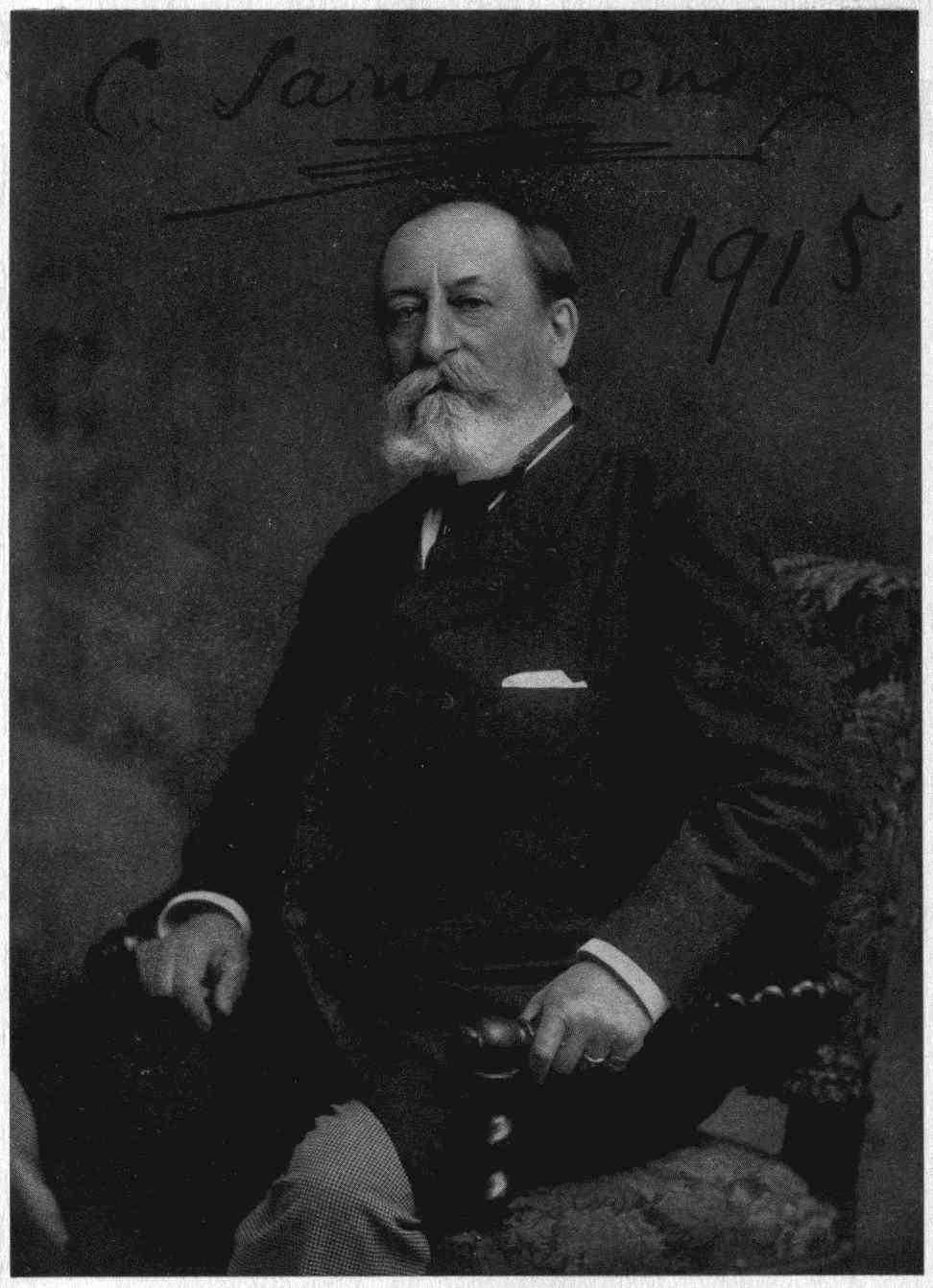
Saint-Saens and the interpretation of ancient music
Produced by Chuck Greif
ON THE EXECUTION OF
MUSIC, AND PRINCIPALLY
OF ANCIENT MUSIC
BY
M. CAMILLE SAINT-SAËNS
Delivered at the
"Salon de la Pensée Française"
Panama-Pacific International Exposition
San Francisco, June First
Nineteen Hundred
& Fifteen
"Salon de la Pensée Française"
Panama-Pacific International Exposition
San Francisco, June First
Nineteen Hundred
& Fifteen
DONE INTO ENGLISH
WITH EXPLANATORY NOTES BY
HENRY P. BOWIE
WITH EXPLANATORY NOTES BY
HENRY P. BOWIE
SAN FRANCISCO:
THE BLAIR-MURDOCK COMPANY
1915
THE BLAIR-MURDOCK COMPANY
1915
Copyright, 1915
by M. Camille Saint-Saëns
by M. Camille Saint-Saëns
ON THE EXECUTION OF
MUSIC, AND PRINCIPALLY
OF ANCIENT MUSIC
 USIC was written in a scrawl impossible to decipher up to the thirteenth century, when Plain Song [1] (Plain Chant) made its appearance in square and diamond-shaped notes. The graduals and introits had not yet been reduced to bars, but the songs of the troubadours appear to have been in bars of three beats with the accent on the feeble note of each bar. However, the theory that this bar of three beats or triple time was used exclusively is probably erroneous. St. Isidore, in his treatise on music, speaking of how Plain Song should be interpreted, considers in turn all the voices and recommends those which are high, sweet and clear, for the execution of vocal sounds, introits, graduals, offertories, etc. This is exactly contrary to what we now do, since in place of utilizing these light tenor voices for Plain Song, we have recourse to voices both heavy and low.
In the last century when it was desired to restore Plain Song to its primitive purity, one met with insurmountable obstacles due to its prodigious prolixity of long series of notes, repeating indefinitely the same musical forms; but in considering this in the light of explanations given by St. Isidore, and in view of the Oriental origin of the Christian religion, we are led to infer that these long series of notes were chants or vocalizations analogous to the songs of the Muezzins of the Orient. At the beginning of the sixteenth century musical laws began to be elaborated without, however, in this evolution towards modern tonal art, departing entirely from all influence of the antique methods. The school named after Palestrina employed as yet only the triads or perfect chords; this prevented absolutely all expression, although some traces of it appear in the "Stabat Mater" of that composer. This music, ecclesiastical in character, in which it would have been chimerical to try to introduce modern expression, flourished in France, in Flanders, in Spain at the same time as in Italy, and enjoyed the favor of Pope Marcellus, who recognized the merit of Palestrina in breaking loose from the grievous practice of adapting popular songs to church music.
In the middle ages, as in antiquity, the laws of harmony were unknown; when it was desired to sing in two parts, they sang at first in intervals of fifths and fourths, where it would have seemed much more natural to sing in thirds and sixths. Such first attempts at music in several parts were made in the thirteenth, fourteenth and fifteenth centuries, when they were hunting for laws, and such music was discordant. It bore the name of Diaphony. The real Polyphony came in the sixteenth century with the school of Palestrina.
Later on, little by little, laws were established, not arbitrarily, but laws resulting from a long experience, and during all the sixteenth century admirable music was written, though deprived of melody, properly speaking. Melody was reserved for dance music which, in fact, was perfectly written in four and even in five part scores, as I have been able to convince myself in hunting for dance music of the sixteenth century for my opera "Ascanio."
But no indication of movement, nuances or shading, enlightens us as to the manner in which this music should be interpreted. At Paris the first attempts to execute the music of Palestrina were made in the time of Louis Philippe, by the Prince of Moscow. He had founded a choral society of amateurs, all titled, but gifted with good voices and a certain musical talent. This society executed many of the works of Palestrina and particularly the famous "Mass of Pope Marcellus." They adopted at that time the method of singing most of these pieces very softly and with an extreme slowness so that in the long-sustained notes the singers were forced to divide their task by some taking up the sound when the others were out of breath. Consonant chords thus presented evidently produced music which was very agreeable to the ear, but unquestionably the author could not recognize his work in such rendering. Quite different was the method of the singers in the Sistine Chapel when I heard them for the first time in Rome in 1855 when they sung the "Sicut Cervus" of Palestrina. They roared in a head-splitting way without the least regard for the pleasure of the listener, or for the meaning of the words they sang. It is difficult to believe that this music was ever composed to be executed in such a barbarous manner, which, it seems to me, differs completely from our musical conceptions; and it is a great mistake also in modern editions of such music to introduce delicate shadings or nuances and even employ the words "very expressive."
Palestrina has had his admirers among French literary writers. We recall the scene created by Octave Feuillet in "M. de Camors." M. de Camors is at his window; a lady is at the piano; a gentleman at the cello, and another lady sings the Mass of Palestrina which I have referred to above. Such a way of playing this music is simply out of the question. Feuillet had obtained his inspiration for this from a fanciful painting which he had seen somewhere.
Expression was introduced into music by the chord of the dominant seventh, the invention of which is attributed to Monteverde. However, Palestrina had already employed that chord in his "Adoremus," but probably without understanding its importance or divining its future.
Before this invention the interval of three whole tones (Triton) was considered an intolerable dissonance and was called "the devil in music." The dominant seventh has been the open door to all dissonances and to the domain of expression. It was a death blow to that learned music of the sixteenth century; it was the arrival of the reign of melody—of the development of the art of singing. Very often the song or the solo instrument would be accompanied by a simple, ciphered bass, the ciphers indicating the chords which he who accompanied should play as well as he could, either on the harpsichord or the theorbe. The theorbe was an admirable instrument which is now to be found only in museums,—a sort of enormous guitar with a long neck and multiple strings which offered great opportunities to a skilful artist.
It is curious to note that in ancient times there was not attributed to the minor and major keys the same character as is assigned them to-day.[2] The joyous canticle of the Catholic church, "O Filii et Filiæ," is in the minor. "The Romanesca," a dance air of the sixteenth century, is equally in the minor, just like all the dance airs of Lully, and of Rameau, and the gavottes of Sebastian Bach. The celebrated "Funeral March" of Haendel, reproduced in many of his works, is in C Major. The delicious love duo of Acis and Galathee, which changes to a trio by the addition of the part of Polyphemus, is in A Minor. When Galathee weeps afterward over the death of Acis, the air is in F Major. It is only recently that we find dance airs in the major mood or key.
From the seventeenth century on, music entered into everyday life, never again to be separated from it. Thus music has remained in favor, and we are continually hearing executed the works of Bach, of Haendel, of Hayden, of Mozart and of Beethoven. How are such works executed? Are they executed as they should be? That is another question.
One source of error is found in the evolution which musical instruments have undergone. In the time of Bach and Haendel the bow truly merited its Italian name of "arco." It was curved like an arc—the hairs of the bow constituted the chord of the arc, a very great flexibility resulting which allowed the strings of the instrument to be enveloped and to be played simultaneously. The bow seldom quitted the strings, doing so only in rare cases and when especially indicated. On this account it happens that the indication of "legato" is very rare. Even though there was a separate stroke of the bow for each note, the notes were not separated one from the other. Nowadays the form of the bow is completely changed. The execution of the music is based upon the detached bow, and although it is easy to keep the bow upon the strings just as they did at the commencement of the nineteenth century, performers have lost the habit of it. The result is that they give to ancient music a character of perpetually jumping, which completely destroys its nature.
The very opposite movement has been produced in instruments of the key or piano type. The precise indications of Mozart show that "non-legato," which doesn't mean at all "staccato," was the ordinary way of playing the instrument, and that the veritable "legato" was played only where the author specially indicated it. The clavecin or harpsichord, which preceded the piano, when complete with two banks of keys, many registers giving the octaves and different tone qualities, oftentimes like the organ with a key for pedals, offered resources which the piano does not possess. A Polish lady, Madame Landowska, has studied thoroughly these resources, and has shown us how pieces written for this instrument thus disclosed elements of variety which are totally missing when the same are played upon the piano; but the clavecin tone lacked fulness, and shadings or nuances were out of the question.
Sonority or tone was varied by changing the keys or register just as on the organ. On the other hand, with the piano one can vary the sonority by augmenting or diminishing the force of the attack, hence its original name of "forte piano,"—a name too long, which was shortened at first by suppressing the last syllables; so that one reads, not without astonishment, in the accounts given of young Mozart, of the skill he showed in playing "forte" at a time when he was playing on instruments of a very feeble tone. Nowadays when athletic artists exert all their force upon the modern instruments of terrific sonority, they are said to play the "piano" (toucher du piano).
We must conclude that the indication "non-legato" finally degenerated into meaning "staccato." In my youth I heard persons advanced in age whose performance on the piano was extremely dry and jumpy. Then a reaction took place. The tyrannical reign of the perpetual "legato" succeeded. It was decided that in piano playing unless indicated to the contrary, and even at times in spite of such indication, everything everywhere should be tied together.[3] This was a great misfortune of which Kalkbrenner gives a manifest proof in the arrangement he has made of Beethoven's symphonies. Besides, this "legato" tyranny continues. Notwithstanding the example of Liszt, the greatest pianist of the nineteenth century, and notwithstanding his numerous pupils, the fatal school of the "legato" has prevailed,—not that it is unfortunate in itself, but because it has perverted the intentions of musical authors. Our French professors have followed the example of Kalkbrenner.
The house of Breitkopf, which until lately had the best editions of the German classics, has substituted in their places new editions where professors have eagerly striven to perfect in their own manner the music of the masters. When this great house wished to make a complete edition of the works of Mozart, which are prodigiously numerous, it appealed to all who possessed manuscripts of Mozart, and then having gathered these most precious documents, instead of reproducing them faithfully, that house believed it was doing well to leave to the professors full liberty of treatment and change. Thus that admirable series of concertos for piano has been ornamented by Karl Reinecke with a series of joined notes, tied notes, legato, molto legato, and sempre legato which are the very opposite of what the composer intended. Worse still, in a piece which Mozart had the genial idea of terminating suddenly with a delicately shaded phrase, they have taken out such nuances and terminated the piece with aforte passage of the most commonplace character.
One other plague in modern editions is the abuse of the pedal. Mozart never indicated the pedal. As purity of taste is one of his great qualities, it is probable that he made no abuse of the pedal. Beethoven indicated it in a complicated and cumbersome manner. When he wanted the pedal he wrote "senza sordini," which means without dampers, and to take them off he wrote "con sordini," meaning with dampers. The soft pedal is indicated by "una corda." The indication to take it off, an indication which exists even now, was written "tre corde." The indication "ped" for the grand pedal is assuredly more convenient, but that is no reason for making an abuse of it and inflicting it upon the author where his writing indicates the contrary.
As it seems to me, it is only from the eighteenth century that authors have indicated the movements of their compositions, but the words which they have employed have changed in sense with time. Formerly the difference between the slowest movement and the most rapid movement was much less than at present. The "largo" was only an "adagio" and the "presto" would be scarcely an "allegro" to-day.
The "andante" which now indicates a slow movement, had at that time its original signification, meaning "going." It was an "allegro moderate." Haendel often wrote "andante allegro." Through ignorance of that fact the beautiful air of Gluck, "Divinities of the Styx," is sung too slowly and the air of Thaos in the "Iphigenia in Tauris" equally so. Berlioz recollected having heard at the opera in his youth a much more animated execution of these works.
Finally, in ancient times notes were not defined as they are to-day and their value was approximative only. This liberty in the execution of music is particularly perceptible in the works of Rameau. To conform to his intentions in the vocal part such music must not be interpreted literally. One must be governed by the declamation, and not by the written note indicating a long or short duration. The proof of this is to be seen when the violins and the voice are in unison—the way of writing them is different.
A great obstacle to executing ancient works from the eighteenth century on is in the interpretation of grace notes, "appoggiaturas" and others. In these cases there is an unfortunate habit in players of conforming to their own taste, which may guide a little, but cannot suffice in every instance. One can be convinced of this in studying The Method of Violin by the father of Mozart. We find there things which one would never dream of.
The "appoggiatura"[4] (from appoggiare, which in Italian means "to lean upon"), should always be long, the different ways in which it may be written having no influence upon its length. There is an exception to this when its final little note, ascending or descending, and preceding the larger note, is distant from it a disjointed degree. In this case it is not an "appoggiatura," and should be played short. In many cases it prolongs the duration of the note which follows it. It may even alter the value of the notes following.
I will cite in connection with the subject of the "appoggiatura" the beautiful duo with chorus of the "Passion According to St. Matthew," and at the same time, I would point out the error committed in making of this passion a most grandios performance with grand choral and instrumental masses. One is deceived by its noble character, by its two choruses, by its two orchestras, and one forgets that it was destined for the little Church of St. Thomas in Leipsig, where Sebastian Bach was organist. While in certain cantatas that composer employed horns, trumpets, trombones and cymbals, for the "Passion According to St. Matthew," he only used in each of the orchestras two flutes, two hautbois, changing from the ordinary hautbois to the hautbois d'amour and the hautbois of the chase,—now the English horn; that is to say, hautbois pitched a third and a fifth lower. These two orchestras and these two choruses then certainly were reduced to a very small number of performers.
In all very ancient music, from the time of Lully, one finds constantly a little cross marked over the notes. Often this certainly indicates a trill, but it seems difficult to take it always to mean such. However, perhaps fashion desired that trills should thus be made out of place. I have never been able to find an explanation of this sign, not even in the musical dictionary of J. J. Rousseau. This dictionary none the less contains a great deal of precious information. Does it not inform us, among other things, that the copyists of former times were veritable collaborators? When the author indicated the altos with the basses, the hautbois with the violins, these copyists undertook to make the necessary modifications. Times have unfortunately changed since.
In Rameau's music, certain signs are unintelligible. Musical treatises of that time say that it is impossible to describe them, and that to understand them it was necessary to have heard them interpreted by a professor of singing.
With clavecinists the multiplicity of grace notes is extreme. As a rule they give the explanation of these at the head of their works, just as Rameau did. I note a curious sign which indicates that the right hand should arrive upon the keys a little after the left. This shows that there was not then that frightful habit of playing one hand after the other as is often done nowadays.
This prolixity of grace notes indulged by players upon the clavecin is rather terrifying at first, but one need not be detained by them, for they are not indispensable. The published methods of those times inform us in fact that pupils were first taught to play the pieces without these grace notes, and that they were added by degrees. Besides, Rameau in transcribing for the clavecin fragments of his operas, has indicated those grace notes which the original did not contain.
Ornaments are much less numerous in the writings of Sebastian Bach. Numberless confusions have been produced in the interpretation of the mordant,[5] or biting note. It should be executed above or below the principal note depending on whether the notes which precede the mordant are superior or inferior to it.
With reference to the difficulties in interpreting the works of Rameau and of Gluck, I would point out the change in the diapason or pitch which at that time was a tone lower than in our days. The organ of St. Merry had a pitch in B flat. In addition to the tempi and the different instruments which make the execution difficult, one must add the recitatives which were very much employed and of which at that time a serious study was made. I recall a beautiful example of recitative in the "Iphigenia in Tauris."
We come now to the modern epoch. From the time of Liszt, who not only revolutionized the performance of music on the piano, but also the way of writing it, authors give to performers all necessary indications, and they have only to carefully observe them. There are, however, some interesting remarks applicable to the music of Chopin which recent editions unfortunately are commencing to falsify. Chopin detested the abuse of the pedal. He could not bear that through an ignorant employment of the pedal two different chords should be mixed in tone together. Therefore, he has given indications with the greatest pains. Employing it where he has not indicated it, must be avoided. But great skill is necessary to thus do without the pedal. Therefore, in the new editions of the author, no account of the author's indications whatever is observed. Thus in the "Cradle Song," where the author has indicated that the pedal be put on each measure and taken off in the middle of it, modern editions preserve the pedal throughout the entire measure, thus mixing up hopelessly the tonic with the dominant, which the composer was so careful to avoid.
A question of the greatest importance in playing the music of Chopin is that of "tempo rubato." That does not mean, as many think, that the time is to be dislocated. It means permitting great liberty to the singing part or melody of the composition, while the accompaniment keeps rigorous time. Mozart played in this way and he speaks of it in one of his letters and he describes it marvelously, only the term "tempo rubato" had not at that time been invented. This kind of playing, demanding complete independence of the two hands, is not within the ability of everybody. Therefore, to give the illusion of such effect, players dislocate the bass and destroy the rhythm of the bar. When to this disorder is joined the abuse of the pedal, there results that vicious execution which, passing muster, is generally accepted in the salons and often elsewhere.
Another plague in the modern execution of music is the abuse of the tremolo by both singers and instrumental performers. With singers, this quivering is often the result of a fatigued voice, in which case it is involuntary and is only to be deplored; but that is not the case with violin and violoncello players. It is a fashion with them born of a desire to make an effect at any cost, and is due to the depraved taste of the public for a passionate execution of music; but art does not live on passion alone. In our time, when art, through an admirable evolution, has conquered all domains, music should express all, from the most perfect calm to the most violent emotions. When one is strongly moved the voice is altered, and in moving situations the singer should make his voice vibrate. Formerly the German female singers sang with all their voice, without any vibration in the sound and without any reference to the situation; one would say they were clarinets. Now, one must vibrate all the time. I heard the Meistersingers' quintette sung in Paris. It was dreadful and the composition incomprehensible. Not all singers, fortunately, have this defect, but it has taken possession of violinists and 'cello players. That was not the way Franchomme, the 'cello player and collaborator of Chopin, played, nor was it the way Sarasate, Sivori or Joachim played.
I have written a concerto, the first and last movements of which are very passionate. They are separated by a movement of the greatest calm,—a lake between two mountains. Those great violin players who do me the honor to play this piece, do not understand the contrast and they vibrate on the lake just as they do on the mountains. Sarasate, for whom this concerto was written, was as calm on the lake as he was agitated on the mountains; nor did he fail on this account to produce always a great effect—for there is nothing like giving to music its veritable character.
Anciently music was not written as scrupulously as it is to-day, and a certain liberty was permitted to interpretation. This liberty went farther than one would think, resembling much what the great Italian singers furnished examples of in the days of Rubini and Malibran. They did not hesitate to embroider the compositions, and the reprises were widespread. Reprises meant that when the same piece was sung a second time, the executants gave free bridle to their own inspiration. I have heard in my youth the last echoes of this style of performance. Nowadays reprises are suppressed, and that is more prudent. However, it would be betraying the intentions of Mozart to execute literally many passages in concertos written by that author for the piano. At times he would write a veritable scheme only, upon which he would improvise. However, one should not imitate Kalkbrenner, who, in executing at Paris the great concerto in C Major of Mozart, had rewritten all its passages in a different manner from the author. On the other hand, when I played at the Conservatoire in Paris Mozart's magnificent concerto in C Minor, I would have thought I was committing a crime in executing literally the piano part of the Adagio, which would have been absurd if thus presented in the midst of an orchestra of great tonal wealth. There as elsewhere the letter kills; the spirit vivifies. But in a case like that one must know Mozart and assimilate his style, which demands a long study.
EXPLANATORY NOTES
[1] Plain Song (Fr. Plain Chant) was the earliest form of Christian church music. As its name indicates, it was a plain, artless chant without rhythm, accent, modulation or accompaniment, and was first sung in unison. Oriental or Grecian in origin, it had four keys called Authentic Modes, to which were added later four more called Plagal Modes. These modes, called Phrygian, Dorian, Lydian, etc., are merely different presentations in the regular order of the notes of the C Major scale—first, with D as the initial or tonic note, then with E et seq. They lack the sentiment of a leading seventh note. In these weird keys Plain Song was conceived for psalms, graduals, introits, and other offices of the primitive church. Such music was generally called Gregorian, because St. Gregory, Pope of Rome in the seventh century, collected and codified it, adding thereto his own contributions. Two centuries previous it was known as Ambrosian music, after St. Ambrose, Bishop of Milan.
Originally, a single chorister intoned the Plain Song, to which a full chorus responded. Later this manner was altered to antiphonal singing—two choruses being used, one for the initial and the other for the responsive chant. Such music thus rendered was singularly grave, dignified, and awe-inspiring.
During the middle ages Plain Song unfortunately degenerated much from its original sacred character, and, in one disguise or another, popular and even indecorous songs were smuggled into it. In the time of Pope Marcellus, 1576, Palestrina was employed to purge Gregorian music of its scandalous laxities.
M. Saint-Saëns, to illustrate the clever way in which popular songs were given an ecclesiastical or Plain Song character, has here added to his luminous lecture the following precious original composition, reproduced in facsimile, in which through ingenious contrapuntal treatment he gives a mock sacred form to an old French ditty, "I Have Some Good Tobacco in My Snuffbox."
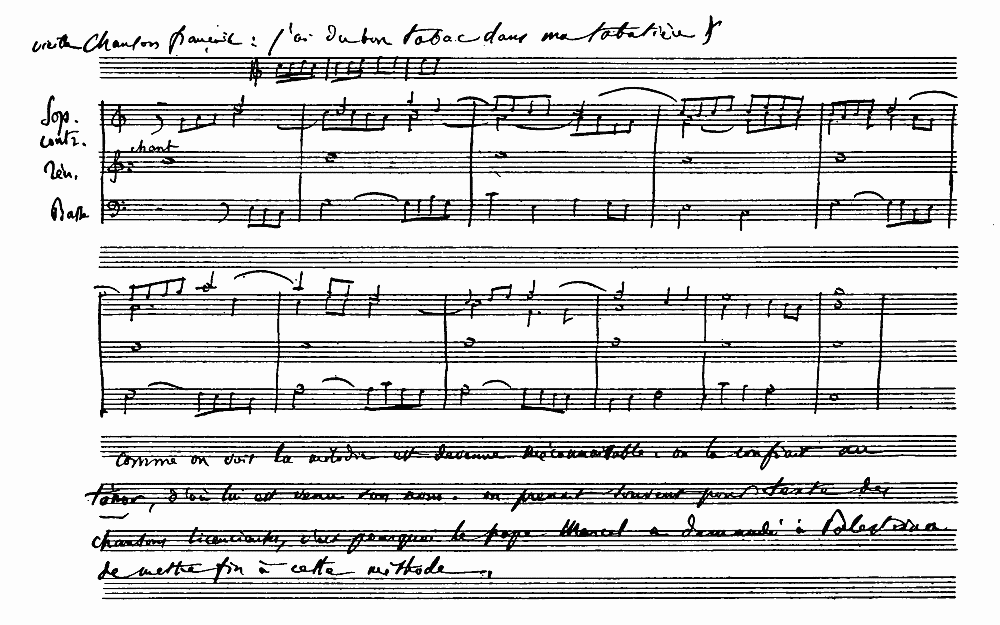
"It is apparent here that by assigning the melody to the tenor part, it is unrecognizable. Oftentimes licentious songs were taken as the Plain Chant text, and on this account Pope Marcellus commissioned Palestrina to put an end to such practices."
In a note he adds: "It must be remembered that before popular songs were thus treated in counterpoint [which means that while the song is being produced by one voice, the other voice or voices are singing against it notes entirely different from the melody], the text for that kind of treatment was the Plain Song—the singing of which was always assigned to the tenor part. In my youth I have heard graduals treated in this fashion at High Mass in my parish church of St. Sulpice in Paris, which is still renowned for the splendor of its ceremonials."

There are here illustrations of (a) the difference between the written manner of Gluck, in a passage from his "Alceste"—and the actually correct way of interpreting and playing it; (b) a passage from the scherzo of Mendelssohn's string quartet,—to show how a gay subject can be treated in the minor mood—and M. Saint-Saëns adds: "Mendelssohn's scherzo of his 'Midsummer Night's Dream' is in sol minor but it evokes no idea of sadness, although oftentimes those who play it, deceived by its minor mood, give it a melancholy character, which is very far from what the composer intended."
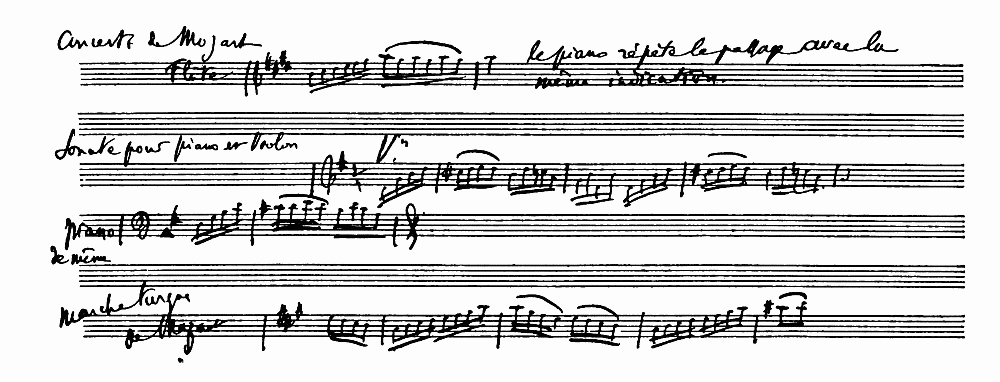
Here M. Saint-Saëns has written a passage from a piano concerto of Mozart to illustrate how that composer wished the non-legato to be interpreted—namely, in a flute-like manner,—the piano repeating textually the passages indicated to be played first by the flutes.
Again he illustrates the same subject with a passage taken from a piano and violin sonata of Beethoven. The non-legatopassages here are not to be played on the violin in a way approaching the staccato, although they are written as detached notes; and the piano part follows the rendering of the violin.
A final illustration is furnished in the "Turkish March" of Mozart.
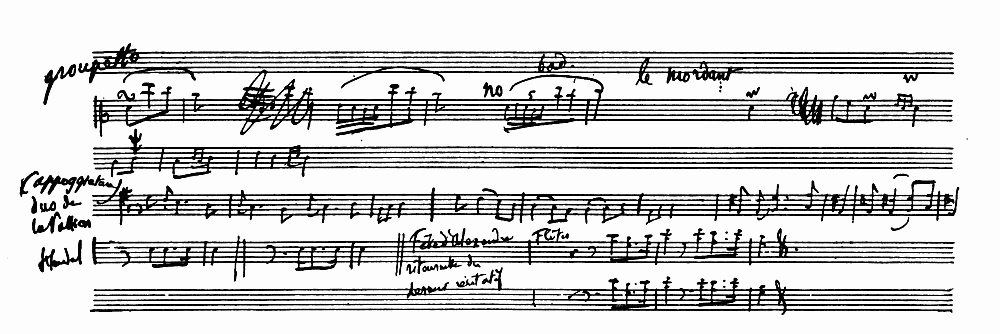
The proper manner of writing the graceful gruppetto is here given—with an illustration following of how it is to be correctly played, and how it is incorrectly executed.
[5] Next is illustrated the two ways of playing the mordant.
[4] Finally, are several examples of the appoggiature,—showing both the way they are written, and the way they are to be executed.
The last line of the music above is an example of how in Haendel the rhythm as interpreted differs from that in which the passage is written.
venerdì 20 luglio 2012
Pleyel Hammers in the Chopin-Era
An article which incorporates a series of period articles and more.
PDF of Pleyel Hammers in the Chopin Era
1842 Pleyel with hatmaker's felt hammers -- Pleyel del 1842 con martelli in feltro di coniglio per cappelli
Here is a piano which has been partially restored with new rabbit-felt used for making hats. The owner of the piano, Gianmaria Bonino is playing. Unfortunately at this time the piano was out-of-tune.
Ecco un pianoforte che è stato parzialmente restaurato, con martelli rifeltrati con feltro nuovo di coniglio, del tipo usato per fare cappelli. Il pianista è il Maestro Gianmaria Bonino, proprietario del pianoforte. Sfortunatamente il pianoforte era scordato.
Iscriviti a:
Post (Atom)